
A child needs to feel your love before they can understand your limits.
“Doctor, my child doesn’t listen to me.”
This is probably one of the most common concerns I hear from parents.
“He says NO to everything.”
“She throws tantrums.”
“He hits me when he’s angry.”
“She wants the phone all the time.”
“If I refuse chocolate, he starts crying.”
“And Doctor, if I become soft, won’t my child become spoiled?”
My answer to parents is simple: your child needs boundaries, absolutely. But before boundaries, your child needs love.
This is what I call Love Before Boundaries.
It doesn’t mean giving your child everything they demand. It doesn’t mean saying yes to avoid a tantrum. And it definitely doesn’t mean allowing hitting, kicking, biting, throwing, unlimited screen time or disrespectful behavior. It simply means: before correcting the behavior, connect with the child. Because a boundary works best when it comes from a person with whom the child feels safe.
· · ·
“Doctor, then Should I Never Say NO ?”
Of course you should say no. Your child asks for a phone during dinner — no. Your child wants another chocolate — no. Your child hits another child — no. Your child wants to run onto the road — absolutely no. Boundaries are essential. But what matters is how we deliver that NO. Imagine your three-year-old wants another chocolate. You say, “No, beta. You’ve already had one.” And suddenly — crying, screaming, kicking. “Mujhe chahiye!”
Now you become angry: “How many times have I told you? Stop crying! You are becoming very stubborn! If you don’t stop, Papa will come!”
The chocolate may have disappeared, but now the connection has disappeared too.
Instead, try this. Come closer. Lower your voice. “You really wanted another chocolate. I know you’re upset.” Then: “But we’ve finished chocolate for today.”
Your child may still cry. That’s okay. The purpose of parenting is not to stop every cry — sometimes crying is simply the child’s way of experiencing disappointment. You don’t have to remove every difficult emotion. You have to help your child move through it safely.
Love Doesn’t Mean Saying YES
This is where many parents get confused.
Love is not “okay, take the chocolate.” Love is “I understand that you’re disappointed.”
Love is not “okay, take the phone so you stop crying.” Love is “I know you want the phone. It’s difficult when screen time ends.”
And the boundary remains: “But the phone is finished.”
Accept the emotion without accepting every behavior.
Your child is allowed to be angry — but not allowed to hit you. Your child is allowed to dislike your decision — but the decision doesn’t necessarily have to change. Your child is allowed to cry because you said no. You can sit beside them while they cry. Love and boundaries can exist together.
Love Says: “I Am Safe”
For a small child, love is not just hearing the words I love you. Love is an experience. When Mumma holds me when I’m upset. When Papa listens to me. When my parents play with me. When they look into my eyes, comfort me, stay with me even when I’m having a difficult moment — the child’s brain slowly learns: “I am loved. I am safe. I belong.”
This becomes the emotional foundation of childhood. And once that foundation is strong, we can build boundaries on top of it.
Love is the root. Boundaries are the structure.
A tree needs both. Without roots, the structure cannot remain strong. But roots alone are also not enough to shape the tree.
Boundaries Say: “I Am Capable”
If love tells a child “I am safe,” boundaries gradually teach “I am capable.” I can wait. I can tolerate hearing no. I can be disappointed and recover. I can share. I can follow a routine. I can respect another person’s body. I can understand that I cannot always get what I want. These are not small skills. These are life skills. Our children will eventually enter a world that will not say yes to everything — rules, waiting, failure, competition, rejection, disappointment, frustration. Our job is not to remove very
frustration from childhood. Our job is to give children a safe relationship in which they gradually learn: “I can handle frustration.”
When Your Child Is in a Storm, Don’t Start Teaching
Imagine your child is on the floor screaming because you switched off the television. And you start: “See, I’ve told you so many times that too much screen affects your eyes. You watched for 30 minutes already. Yesterday also you behaved like this…” Your explanation may be completely correct. But your timing is wrong. A child in the middle of an emotional storm is not ready for a lecture.
Regulate → Connect → Teach
During the storm, use fewer words. “I know you’re angry.” “I’m here.” “I won’t let you hit.” That’s enough.
Once your child is calm, then teach: “Next time you’re angry, tell Mumma, ‘I’m angry.’ You can ask for help. But we don’t hit.”
Teaching happens between storms, not necessarily at the peak of the storm
“But Doctor, My Child Hits Me!”
Then the boundary needs to be very clear. Suppose you refuse the phone and your child hits you. Don’t laugh. Don’t hit back. Don’t give the phone. And don’t start a five-minute lecture. Gently stop the hand and say: “I know you’re angry. I won’t let you hit me.”
LOVE says
“I understand your emotion.”
BOUNDARY says
“I will not allow this behavior.”
This is not permissive parenting. This is parenting with warmth and leadership.
Love Before Boundaries Does Not Mean Love Instead of Boundaries
This distinction is extremely important. If every time your child cries you change your decision, the child learns something very different.
Monday: “No phone while eating.” Child cries. Phone comes.
Tuesday: “No phone.” Child screams louder. Phone comes.
Wednesday: the parent says, “Doctor, he doesn’t eat without the phone.”
Children learn through repetition. If NO repeatedly becomes YES after enough crying, the child learns:
“Maybe I just need to continue.” This doesn’t make your child bad or manipulative — your child is simply learning from the pattern we created.
Soft heart. Clear boundary.
Sometimes the Boundary Is for the Parent Too
We talk a lot about children’s behavior. But sometimes we need to look at our own.
We tell our children “don’t shout” while shouting.
We say “keep the phone away” while scrolling through our own phone
We say “control your anger” while losing control of ours.
Children don’t learn emotional regulation only from our instructions. They learn by watching us regulate ourselves. So when your child is having a tantrum, sometimes the first person who needs to regulate is not the child. It’s us.
Take a second. Lower your voice. Slow your reaction. Then respond. Your calm doesn’t guarantee that your child will immediately become calm — but it gives the child a regulated adult to return to
Build Love When There Is No Problem
Don’t wait for a tantrum to connect with your child. Build connection every day. Ten minutes of undistracted play. A bedtime story. A hug before school. Eating together. Walking together. Listening to a completely random story your child desperately wants to tell you. Looking into their eyes. Laughing together. Putting your phone away when they are talking. These tiny moments tell your child: “You matter to me.” Bonding is not built during one expensive vacation. It is built during
hundreds of ordinary moments.
Love + Boundaries
Parenting, for me, stands on two pillars.
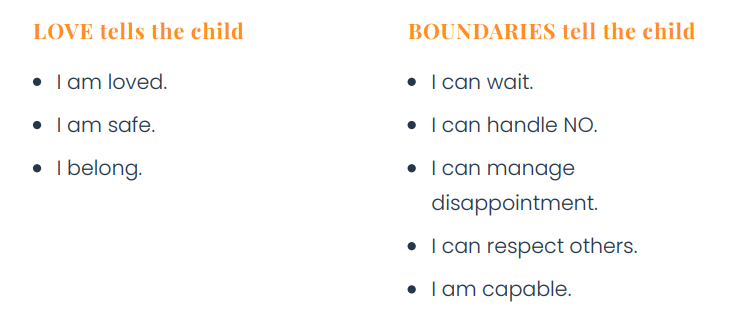
Remove love, and boundaries may start feeling like control. Remove boundaries, and love can drift into permissiveness. Children need both. But remember the sequence: Love Before Boundaries. Not because boundaries are less important — but because connection creates the foundation from which boundaries can
teach.
So tomorrow, when your child screams…
When your toddler says NO…
When the phone needs to be switched o”…
When chocolate is refused…
When bedtime becomes a battle…
Don’t ask only, “How do I stop this behaviour?” Ask, “What is my child feeling?”
Connect. Then hold the boundary. And when the storm settles, teach. You don’t need to be a perfect parent. You need to be a parent who keeps coming back to love, connection and consistency.
Remember: Love first. Boundary next. Teaching later.
Your child doesn’t need you to say YES to everything. Your child needs to know that even when the answer is NO, your love remains YES.
That is Love Before Boundaries.
— Dr. Santosh Yadav
Pediatrician & Neonatologist, Surat